

Dynamic terahertz wavefront control using stretchable single-walled carbon nanotube-based metasurfaces
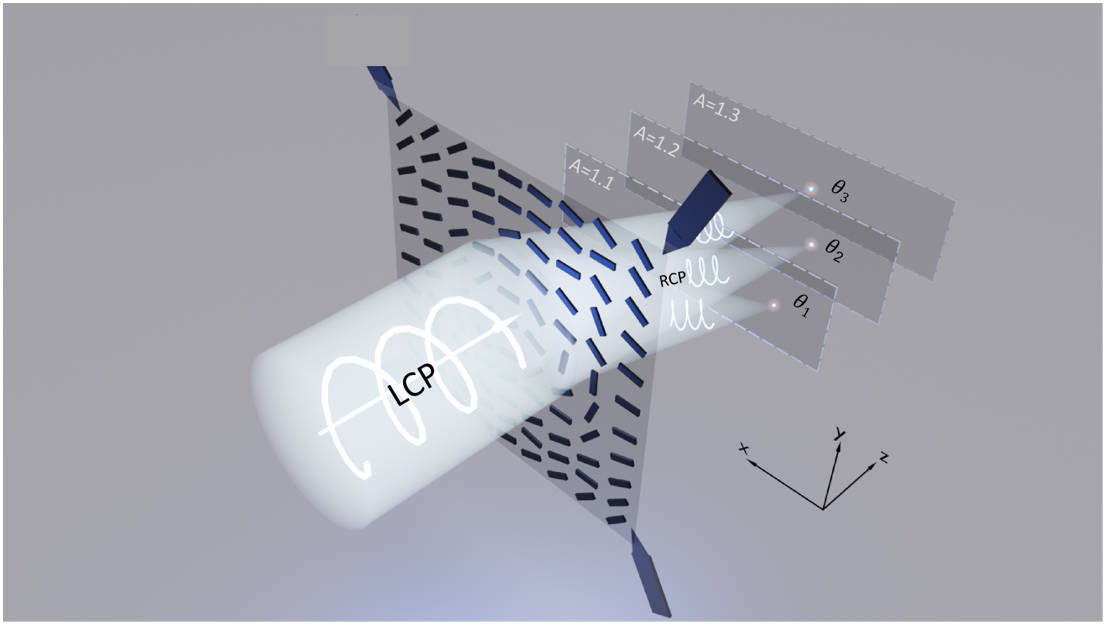
Schematic of the SWCNT-based stretchable metasurface for THz wavefront manipulation.
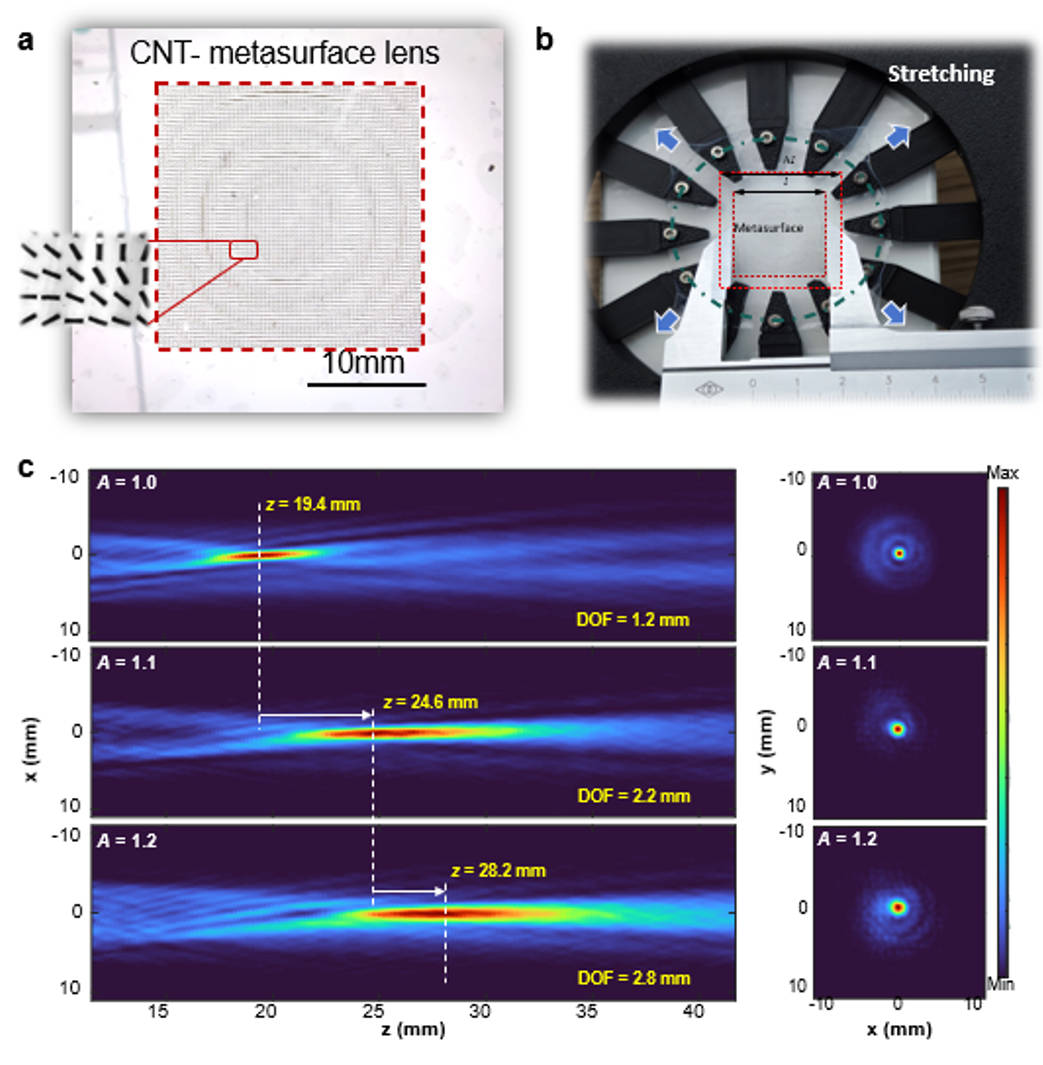
Focal-length-tunable SWCNT-based metasurface lens.
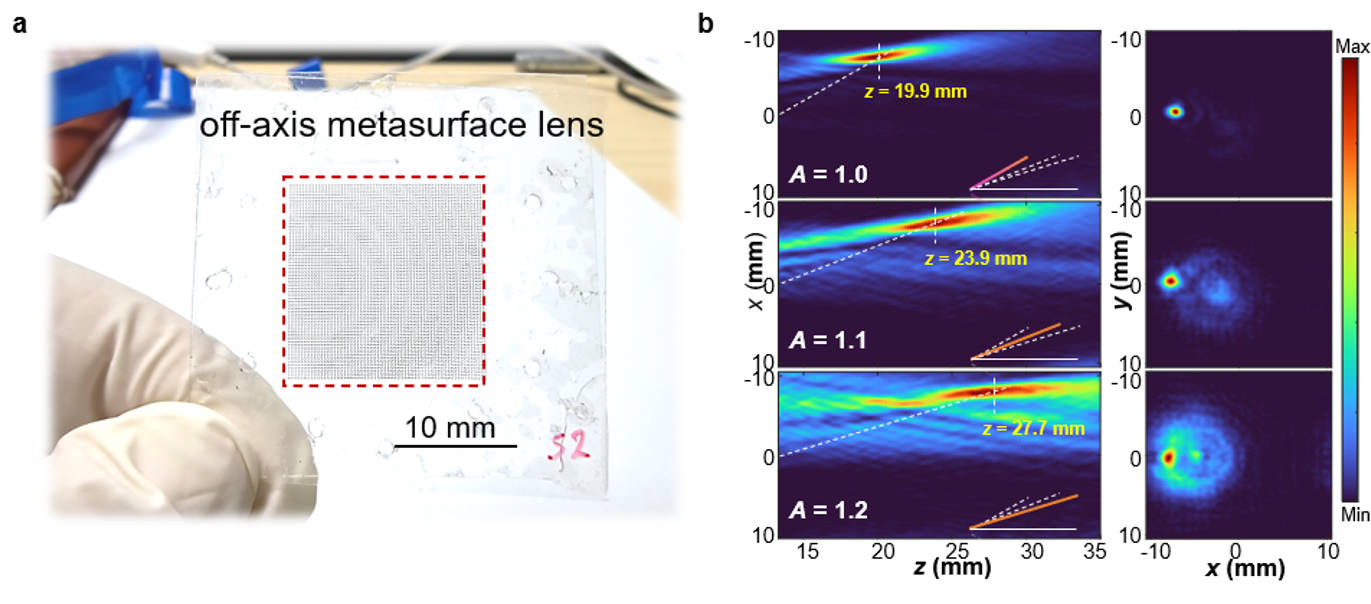
Dynamic beam steering demonstration with the off-axis metasurface lens.
GA, UNITED STATES, June 4, 2026 /EINPresswire.com/ -- Dynamically tunable terahertz (THz) wavefront modulators are essential components for next-generation communications. Researchers from China and Russia have designed and fabricated two stretchable metasurfaces based on single-walled carbon nanotube (SWCNT) film: a focal-length-tunable metasurface lens and another for controllable beam deflection. By applying mechanical stretching, these devices achieve superior dynamic terahertz wavefront manipulation and continuous tuning at 0.35 THz. This work lays a foundation for smart, wearable THz components in 6G communication and intelligent sensing.
The terahertz (THz) frequency regime, sitting between microwaves and infrared light, has long promised revolutionary advances in wireless communication, security imaging, and non-destructive sensing. A key roadblock, however, has been the lack of compact, dynamically tunable components capable of manipulating THz beams on demand. While metasurfaces — ultrathin arrays of subwavelength resonators — have enabled unprecedented control over electromagnetic waves, the vast majority remain static after fabrication, severely limiting their utility in dynamic real-world scenarios.
In a new paper published in Light: Advanced Manufacturing, a team of scientists, led by Professor Yan Zhang from Capital Normal University (China), in close collaboration with researchers from Beijing Jiaotong University, the Moscow Center for Advanced Studies, the Prokhorov General Physics Institute of RAS, the University of Otago, Harbin Institute of Technology, and the Skolkovo Institute of Science and Technology, have demonstrated a novel solution: stretchable THz metasurfaces built from single-walled carbon nanotube (SWCNT) film on silicone substrate that enable dynamic wavefront control through simple mechanical deformation. These researchers summarize their investigations:
“Unlike conventional plasmonic metasurfaces, which rely on metallic patterns that are prone to cracking under strain, our SWCNT-based design leverages the intrinsic elasticity and high electrical conductivity of the nanotubes to maintain optical functionality over repeated deformation cycles. We designed and experimentally demonstrated two functional SWCNT-based metasurfaces. Each metasurface device has an area of 21 mm × 21 mm and consists of 60 × 60 rectangular rods of SWCNT film with different orientations, supported by a silicone substrate. ”
“The first designed device is a focal-length-tunable metasurface lens. When a 0.35 THz left-handed circularly polarized (LCP) wave passes through the lens, its right-handed circularly polarized (RCP) component focuses at a distance of 19.4 mm. By applying uniform mechanical stretching to the sample, the focal point continuously shifts backward as the stretching strain increases, resulting in a significant increase in the focal length. Figure 2 presents photographs of the fabricated SWCNT metasurface lens and the stretching fixture, along with the experimentally measured evolution of the optical field.”
“The second device is a dynamic beam-steering off-axis metasurface lens. Driven by mechanical stretching, it simultaneously achieves longitudinal displacement of the focal point and lateral beam deflection. Experimental measurements show that in the unstretched state, the focal point is located at z = 19.9 mm with a beam deflection angle of -19.69°. When the stretching factor (A) is increased to 1.2, the focal point shifts to 27.7 mm, and the beam deflection angle changes from -19.69° to -16.01°, corresponding to a relative deflection shift of 3.68°. These experimental results validate the capability of mechanically tunable beam steering for terahertz waves. Figure 3 presents photographs of the beam-steering metasurface lens and the experimentally measured evolution of the optical field.”
"The presented technique opens a new avenue for smart, lightweight, and wearable THz components," the researchers forecast. "We envision this platform evolving into fully programmable and adaptive photonic systems, where THz beams can be manipulated as effortlessly as one stretches a rubber sheet. Such capabilities will be instrumental for future 6G wireless networks, real-time security screening, and intelligent human-device interactive interfaces."
Original Source URL
https://doi.org/10.37188/lam.2026.066
Funding information
This work was supported by the National Natural Science Foundation of China under Grant Nos. 62005020 and 12574421; the Ministry of Science and Higher Education of the Russian Federation under Grant No. FSMG-2025-0005; and the Russian Science Foundation under Grant No. 22-13-00436 (SWCNT synthesis).
Lucy Wang
BioDesign Research
email us here
Legal Disclaimer:
EIN Presswire provides this news content "as is" without warranty of any kind. We do not accept any responsibility or liability for the accuracy, content, images, videos, licenses, completeness, legality, or reliability of the information contained in this article. If you have any complaints or copyright issues related to this article, kindly contact the author above.
